

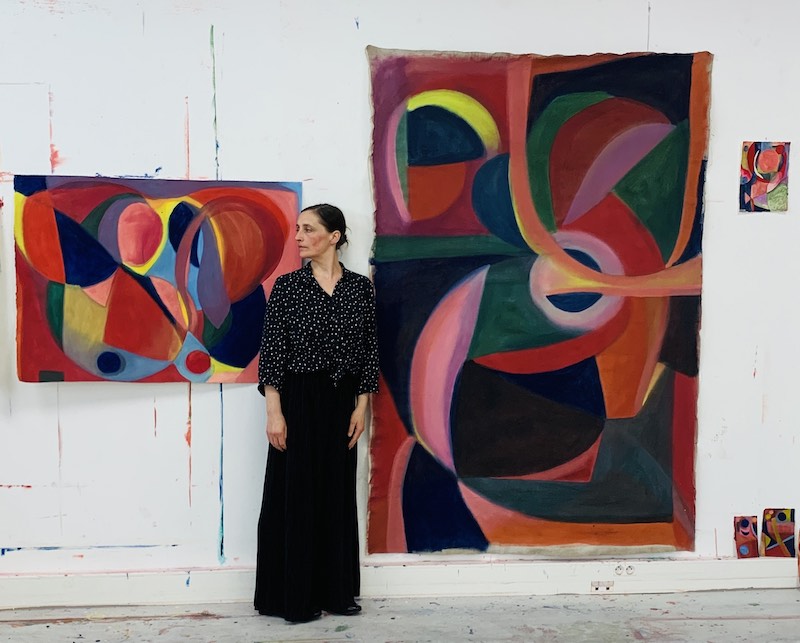
Denervaud doesn’t limit herself to any artistic trend. She likes to think of her work as a spontaneous process that experiments with movement and color done in the solitude of her studio. Against the rush and tension of modern times, her videos and paintings offer a peaceful space in which no meaning is imposed and the spectator is free to feel.
Caroline Denervaud is a Swiss born multidisciplinary artist based in Paris that stands out for her unique way of combining dance and paint into her artworks. Her first passion was contemporary dance, which she was studying at Trinity Laban College in London until a bad injury forced her to quit. To cope with the pain, she decided to follow a friend who was living in Paris and ended up studying Fine Arts at the École Nationale Supérieure des Beaux Arts (ENSBA), and Fashion in Studio Berçot. From these myriad of experiences Denervaud created a singular way of performing arts. The paintings, which result from traces made by her own body movements on the canvas, are raw, energetic and marked by a distinctive color palette.

The freedom and liveliness that distinguishes the artist’s way of work is attractive to both the fashion and the art world since she has exhibited her pieces in galleries and art fairs like DoubleV Gallery, as well as being commissioned decorative paintings for spaces such as the NoMad Hotel in London.
Pioneer in her field of work, Denervaud’s pieces are driven by a feminine energy with no boundaries. Its beauty resides in losing the grip in a world overflowed with information and violence, and going after the simplicity of an imperfect moment, to let go into a feeling, a sequence, a memory, a story.
What artists inspired you to become a multidisciplinary artist?
I started with dance and my model was Pina Bausch, also women like Martha Graham, but the poetry of Pina Bausch, the way she can really express emotions and narrate very strong poetical stories through movement, that’s what I like the most. Movement was my way to say things when I was a teenager, it was the easiest way for me.

Can you talk about your artistic process?
It happens like a performance. I have a canvas on the floor, I choose the clothes and I film myself and the process. When I consider it is the end, I stop and I don’t come back, never. I start with the movement, Is really like an improvisation, one short movement after the other to let the feeling appear. I try to keep the brain off in this part. Sometimes it is really nothing, just the body itself being there and moving, I mean it is very simple. So, the movements of the body creates marks and at the end these build a structure for the future painting to come. Then I paint trying to reveal the story with color.
Do you study the election of color?
No, it is spontaneous. I build the color myself, in my “kitchen” as I call it, so I kind of choose the color I want for my painting, but it is never the one that stays at the end. The pigments can make the painting look old, it’s old-fashioned to build your own paintings. I have some colors that I use all the time because they are easy for me, like pink. Pink is always the first, and even if at the end there is no pink in the painting, it is there to do the first tones.
And once you finish a painting you let it go?
Yes, I like working on them and then letting them go. I like the fact that paintings are shown, that they are visible to other people and that they go to other places after. If they don’t go away, though they can be hanging in my studio, I don’t look at them.
Do you think you paint for yourself or for others to see?
I paint for myself, definitely. That is why I choose to be alone in my studio.
The fact that spontaneity and the ephemeral are so important to you, does it have to do with the way you view life?
Yeah, I think that when I am sure about something, that something loses its interest. If it’s ephemeral, if I don’t know where I am going, if it surprises me, that is what I love, what I think it’s interesting in life. When I move I don’t choreograph beforehand, so when I see the video I discover what happened and I am surprised by it.

Do you think your infancy influenced your life?
I didn’t have an artistic uprising but it did influence my art because my parents were different from the other parents, we traveled a lot and they never told me: “This is nice, your interest has to go there”, they let me be very free and encouraged me to find what I love. I think that because my parents weren’t educated in art, I didn’t have that intellectual viewpoint until I studied art, but they were very curious and let me be curious by myself. My mom took contemporary class lessons, so I took classical and contemporary lessons throughout my childhood and teenagehood. It was where I felt alive. Sometimes I notice I have to think more about the purpose and the focus, but I find it more important to accept what happens and not always try to reshape and rebuild to make it look better or perfect. It is the beauty of the moment, and the process is about taking the time to accept and see how it turned out. I like it raw, I don’t want to make it nicer than it is.
Until what age were you a full time dancer?
I have been dancing every day since I was 20. I wanted to become a professional dancer so I was learning in London, but then I had an accident so I stopped everything and after that it was very difficult even to see dance. Then I realized that even throughout being there, you know, talking, walking, doing your stuff, you use your body all the time. And because it is yours, you use it in a particular way different from any other body, it tells a lot about you.

Why did you move to Paris?
I was in London studying dance but I broke my knee, so I couldn’t go on dancing professionally anymore. It was a physical pain logically, but also a mental one because I had to leave my dream. I didn’t want to return home to my parents so I followed a friend who was living here.
Do you miss being a full time dancer?
No, I would love to do something on stage one day, but I dance in my studio, that is okay for me, and also now more and more dance without dancing. I am dancing inside but you can’t see it, and it is fascinating, it is a fluidity inside.
Would you say your artworks are documentaries of the possibilities of the body?
Yeah, it can be. But I believe that if you don’t know the process or watch the videos, you don’t know the painting was built from movement, and it’s okay too. I think a video and a painting can live by themselves.
Can you talk about your last sólo exhibition, Fugue?
It was the title of the main piece of the exhibition. A fugue is a little escape, you have to escape to see something else and then you come back. Like teenagers, they leave home, they try, they see something different, but then they return. It was a fugue for the spectators. The tone of the exhibition was happy because it was after the lockdown, the first month we were able to go out.

Is there a message that you want to portray in your paintings for the audience, or do you prefer to leave it to free interpretation?
What I really hope that happens is that they find the meaning by themselves, something to think about, an emotion. Is their job, they have to be there and if they don’t feel something or they don’t understand, that is valid too. When you see a painting, watch a dance, listen to music, sometimes you don’t know exactly why you feel something, why you are happy with it, you want to see it again, or you think about it frequently. It leads you to another part of your life or simply resonates in you, and that is the beauty of art.
Maybe that is why you choose to do abstract paintings.
Yeah, and everyday I go to the studio, I am alone and I go into my world. We are so much exposed to what to see, what to think, what happens in the world all the time… What I want to offer is the opposite, it’s more like poetry or like a dream, I mean just peace. I don’t have anything to tell people to think or see.
How did studying fashion influence your work?
The director at Studio Berçot, Marie Rucky, was an incredible lady and she told us how to imagine, build and create clothes and a collection, but mostly she taught us to find who we are and to understand that our background and essence is the base from which you can create. It was interesting to see how all the students wanted to build from something they had seen, from a personality, or something they wanted, like a projection; but it is not you and as it is not you, it’s not true. What I learnt from that school was mostly to be myself, you can try to escape but you will come back for sure, and that will be your support, and you will bring something to the world from who you really are. I also learnt about colors. Rucky always said that a nice color palette is just nice, just nice is not interesting, you have to bring something that disturbs. It’s always about the movement, about not finishing, about not being perfect. If it’s too perfect, too armonious it’s nice, but we want something alive, not something nice.
So what would be the key points in your art?
Energy, center, color, movement. There is also a play between balance-imbalance. If it’s balanced it’s stuck, but when you are staying in one feet, and then you become tired and fall, it’s interesting, something is happening. And now what is important for me is to let the movement be more visible in the painting.
To what degree are the clothes you wear important in your paintings? I imagine selecting them is part of the ritual.
Is like going on stage and having a custom. The clothes change a lot the way I move. If it’s tight it will change my movement, if it’s wide too. I like to play with it, to hide parts of the body inside. The shape is also important, and if the color is clear or dark. Since the videos are always in black and white, if I want the marks to be visible I choose clear clothes.
What are you trying to do with the music you choose?
It’s very rare that I perform with music because I think music is so strong it will lead everything, and I don’t want to be led by a sound. If I want to be truly in my story I have to do it in silence or with a repetitive melody. Only when the video is done I can add a song to it. I once did a video with a sound that a musician created for me, and I decided not to listen to it, but to discover it while performing. I had no expectations, I was discovering music while performing. I chose not to hear it before because I saw that if you knew the music, even if you listen to it once, you feel something or you think about something, or you love it or you don’t like it, something happens with that music and you, and it will affect what I was doing. I wanted it to be a live thing.
What do you think attracts people to your work?
We know everything that happens in the world, second by second, and we always know the awful stuff, what is beautiful it’s never shown. I think we need beauty as well. Beauty, poetry…simple things. We can’t live only on awful things.